कंप्यूटर नेटवर्क का इतिहास

Distribute Education like Computer Geek

Networks के अस्तित्व में आने से पहले की दुनिया

.

यह समझने के लिए कि computer networks का जन्म कैसे हुआ, आपको पहले यह समझना होगा, कि वे किस समस्या को हल करने के लिए बनाया गया था। और इसके लिए हमें 1950s के दौर में जाना होगा, जब computers न तो personal थे, न portable थे, और निश्चित रूप से ऐसे नहीं थे कि आपके जैसे कोई छात्र उन्हें खरीद सके या आसानी से उपयोग कर सके।

उन दिनों एक ही प्रकार का computer था, जो पूरी computing दुनिया पर हावी था – Mainframe.

MainframesThe Giants

कल्पना कीजिए, एक ऐसे computer की जो पूरे कमरे जितना बड़ा हो। आपकी मेज पर कोई keyboard नहीं। आपके सामने कोई screen नहीं। केवल एक विशाल और अत्यंत महंगी machine, जिसकी कीमत कभी-कभी किसी इमारत से भी अधिक होती थी।
ये Mainframes विशेष air-conditioned कमरों में रखे जाते थे, जिन्हें प्रशिक्षित operators की एक टीम संचालित करती थी, और जिनका उपयोग पूरा organisation करता था।

Mainframes के साथ काम करने का तरीका आज के computers से बिल्कुल अलग था। आप सीधे machine के साथ interact नहीं करते थे। इसके बजाय, आप अपने program को punch cards नामक कागज़ी cards पर punch करते थे, और उन्हें operator को जमा कर देते थे, फिर प्रतीक्षा करते थे। कभी कई घंटे, तो कभी अगले दिन तक।

Operator उन cards को machine में डालता था, machine आपके program को batch mode में चलाती थी (अर्थात एक समय में एक job, बिना किसी interruption के), और अंत में आपको printed result मिलता था। इस प्रक्रिया को batch processing कहा जाता था।

IBM जैसी कंपनियों ने 1950s और 1960s में इन machines का निर्माण किया।

लेकिन यहाँ एक बड़ी सीमा थी। ये Mainframes एक-दूसरे से बात नहीं कर सकते थे। यदि UCLA University के पास एक Mainframe था और SRI University के पास भी एक Mainframe था, तो उनके बीच data share करने का कोई तरीका नहीं था।

यदि UCLA का कोई researcher कोई program लिखता और उसे SRI भेजना चाहता, तो उसे वास्तव में उस program को कागज़ पर लिखना पड़ता और डाक के माध्यम से भेजना पड़ता। एक computer का दूसरे computer से electronic रूप से, शहरों और राज्यों के पार communication करने का विचार तब तक अस्तित्व में नहीं था।

यही वह कमी थी जहाँ से computer networking की कहानी शुरू होती है।

.

Advanced Research Projects Agency (ARPA)

1960s के मध्य तक, ARPA में कार्यरत J.C.R. Licklider नामक वैज्ञानिक ने एक ऐसी प्रणाली की कल्पना की जिसमें कोई भी व्यक्ति, कहीं से भी, network में मौजूद किसी भी computer के programs और data तक पहुँच सकता था।

मुख्य technical समस्या यह थी कि लंबी दूरी के connection पर data को विश्वसनीय तरीके से कैसे भेजा जाए।

यदि आप दो शहरों के बीच एक dedicated telephone line का उपयोग करते हैं, तो पूरी call के दौरान वह line केवल उसी communication के लिए व्यस्त रहती है। इसे circuit switching कहा जाता है, जिसके बारे में हम आगे आने वाले posts में विस्तार से पढ़ेंगे।

RAND Corporation के researcher Paul Baran ने एक बेहतर विचार प्रस्तुत किया। उन्होंने सुझाव दिया कि data को एक बड़े message के रूप में भेजने के बजाय उसे छोटे-छोटे हिस्सों में बाँट दिया जाए, जिन्हें packets कहा जाए।

प्रत्येक packet, network के माध्यम से स्वतंत्र रूप से यात्रा कर सकता है, और destination पर पहुँचने के बाद सभी packets को दोबारा जोड़कर original message प्राप्त किया जा सकता है। उन्होंने इस विचार को packet switching नाम दिया।

यदि कुछ packets, network में अलग-अलग रास्तों से भी जाएँ, तब भी वे destination तक पहुँचकर पुनः एकत्रित किए जा सकते हैं। यही विचार UK में Donald Davies द्वारा भी स्वतंत्र रूप से विकसित किया गया था।

1967 में ARPA ने packet switching पर आधारित network के design को स्वीकृति प्रदान कर दी।

.

The Four Universities
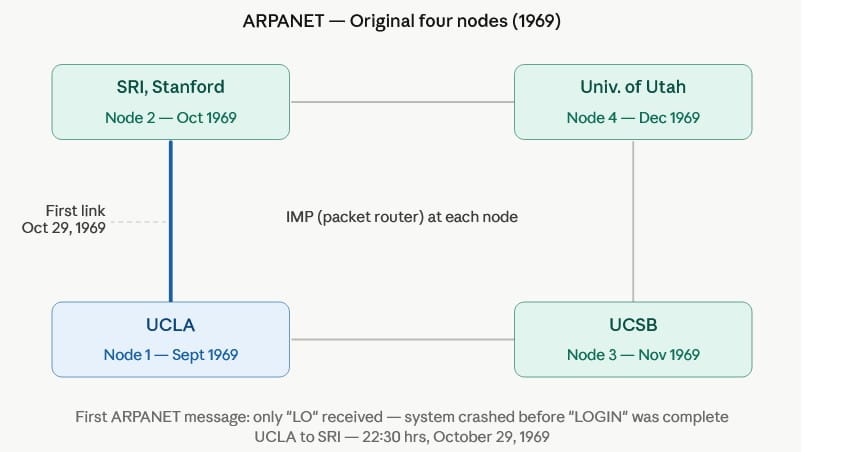
Four Universities that has the network

ARPANET की शुरुआत चार universities से हुई थी। इन universities को इसलिए चुना गया क्योंकि इनके पास मजबूत computer science research programs थे, और इन्हें पहले से ARPA funding प्राप्त हो रही थी।

Node 1UCLA (University of California, Los Angeles), September 1969 में जोड़ा गया। UCLA network का पहला node था और यह Network Measurement Centre के रूप में कार्य करता था।

Node 2SRI (Stanford Research Institute, Stanford), October 1969 में जोड़ा गया। SRI में Network Information Centre था, जो मूल रूप से internet के लिए एक प्रारंभिक telephone directory जैसा था।

Node 3UCSB (University of California, Santa Barbara), November 1969 में जोड़ा गया। UCSB, network का उपयोग करके interactive mathematics और 3D graphics पर कार्य कर रहा था।

Node 4University of Utah, December 1969 में जोड़ा गया। Utah अपने computer graphics research के लिए प्रसिद्ध था।

ARPANET पर भेजा गया पहला message, UCLA से SRI को 29 October 1969 को रात 10:30 बजे भेजा गया था।

UCLA की टीम SRI computer में login करने का प्रयास कर रही थी और उन्होंने “LOGINcommand टाइप की।

वे सफलतापूर्वक केवल “L” और “O” अक्षर भेज पाए, और उसके तुरंत बाद SRI का computer crash हो गया।

इस प्रकार तकनीकी रूप से उस network पर भेजा गया पहला message, जो आगे चलकर Internet बना, केवल इतना था – “LO”.

मानो network स्वयं पूरी दुनिया को hello कह रहा हो।

.

IMP – (The Device That Made It All Possible)

यह एक ऐसी बात है जिसका उल्लेख अधिकांश textbooks बहुत संक्षेप में करती हैं, जबकि यह अधिक विस्तार से समझने योग्य है।

जब हम कहते हैं कि “UCLA was connected to SRI”, तो इसका अर्थ यह नहीं है कि दोनों Mainframe computers सीधे physical wires से जुड़े हुए थे।

उनके बीच एक विशेष device मौजूद थी जिसे IMP कहा जाता था, जिसका पूरा नाम Interface Message Processor था।

IMP मूल रूप से दुनिया का पहला router था।

यह एक छोटा dedicated computer था जिसका एकमात्र कार्य data packets को प्राप्त करना, यह निर्धारित करना कि उन्हें आगे कहाँ जाना है, और फिर उन्हें सही दिशा में भेजना था।

चारों university nodes का अपना-अपना IMP था।

ये IMPs leased telephone lines के माध्यम से एक-दूसरे से जुड़े हुए थे, जबकि प्रत्येक university का Mainframe computer स्थानीय रूप से अपने IMP से जुड़ा रहता था।

जब UCLA को SRI को कोई message भेजना होता था, तो message पहले UCLA Mainframe से UCLA के IMP तक जाता था।

इसके बाद UCLA का IMP telephone line के माध्यम से उसे SRI के IMP तक भेजता था।

फिर SRI का IMP उस message को SRI Mainframe तक पहुँचा देता था।

Mainframes को routing की complexity के बारे में कुछ भी जानने की आवश्यकता नहीं थी। यह पूरा कार्य IMP का था।

कार्यों का यह विभाजन, आज भी networking का एक महत्वपूर्ण सिद्धांत है।

आपका phone स्वयं internet packets को route करना नहीं जानता। यह कार्य आपका router करता है।

IMP उन सभी routers का पूर्वज था जिन्हें आपने आज तक देखा है।

.

FLAG DAY

1 January 1983 को, जिसे networking history में कभी-कभी “Flag Day” कहा जाता है, ARPANET ने आधिकारिक रूप से अपने core protocol को TCP/IP में बदल दिया| वही protocol जिसका उपयोग आज Internet करता है।

इस क्षण को अक्सर आधुनिक Internet का जन्मदिन माना जाता है।

1991 तक, CERN में कार्यरत British scientist Tim Berners-Lee ने World Wide Web का आविष्कार किया, जो pages, links और browser की सहायता से Internet पर information को व्यवस्थित करने का एक तरीका था।

लोग अक्सर Web और Internet को एक ही चीज़ समझ लेते हैं, जबकि ऐसा नहीं है।

Internet – वह physical और logical network infrastructure है।

Web – एक application है जो Internet के ऊपर कार्य करती है।

.

Internet vs internet

जब आप “internet” (छोटे i के साथ) लिखते हैं, तो आप किसी भी ऐसे network collection की बात कर रहे होते हैं जिसमें कई networks आपस में जुड़े हुए हों।

इस अर्थ में, आपके college का local network, hostel के Wi-Fi और library के server से जुड़कर एक छोटा internet बना सकता है।

जब आप “Internet” (बड़े I के साथ) लिखते हैं, तो आप उस विशेष global public network की बात कर रहे होते हैं जो दुनिया भर में अरबों devices को जोड़ता है।

यही वह network है जिसका उपयोग आप यह content पढ़ने, emails भेजने, YouTube देखने और लगभग हर digital कार्य के लिए करते हैं।

.

How the Internet is OrganisedThe Hierarchy

Internet की संरचना layered और hierarchical होती है, जो Internet Service Providers (ISPs) की अवधारणा पर आधारित है।

इस hierarchy को समझना आवश्यक है ताकि यह समझा जा सके कि आपका data वास्तव में आपके phone से America या Japan में स्थित किसी server तक कैसे पहुँचता है।
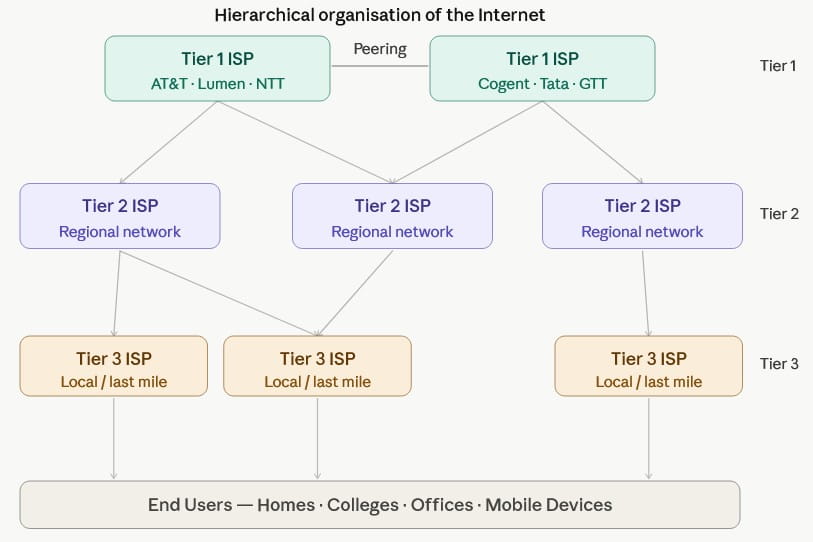
Hierarchichal ISPs - History of CN

International ISPs – (Tier 1)

ये AT&T, Lumen Technologies, NTT, Cogent और Tata Communications जैसी विशाल कंपनियाँ होती हैं जो Internet के physical backbone का स्वामित्व और संचालन करती हैं।

इनके पास हजारों किलोमीटर लंबी high-speed fibre optic cables होती हैं, जिनमें समुद्र के नीचे बिछाई गई undersea cables भी शामिल होती हैं।

ये कंपनियाँ peering agreements के माध्यम से एक-दूसरे से जुड़ती हैं।

Peering agreement का अर्थ है कि दोनों पक्ष बिना किसी शुल्क के traffic exchange करने पर सहमत होते हैं क्योंकि दोनों को समान लाभ प्राप्त होता है। इसे settlement-free peering कहा जाता है।

.

National ISPs – (Tier 2)

ये International ISPs से जुड़ते हैं और transit के लिए भुगतान करते हैं, अर्थात Tier 1 backbone के माध्यम से traffic भेजने का अधिकार प्राप्त करते हैं।

भारत में BSNL, Reliance Jio और Airtel जैसी कंपनियाँ इस स्तर पर या इसके बहुत निकट कार्य करती हैं।

एक Tier 2 ISP बेहतर efficiency के लिए अन्य Tier 2 ISPs के साथ भी peering कर सकता है, लेकिन अंततः global Internet के सभी भागों तक पहुँचने के लिए उसे Tier 1 पर निर्भर रहना पड़ता है।

.

Local ISPs – (Tier 3)

ये ISPs local access providers होते हैं।

यही वे कंपनियाँ हैं जो वास्तव में आपके घर, hostel या college तक internet connectivity पहुँचाती हैं।

वे Tier 2 ISPs से transit खरीदते हैं और उसे end users को उपलब्ध कराते हैं।

आपके घर और निकटतम Tier 3 ISP cabinet या exchange point के बीच का connection, last-mile connection कहलाता है, और अक्सर यही internet speed का सबसे बड़ा bottleneck होता है।

यही hierarchy Internet को उसकी reliability प्रदान करती है।

यदि आपके स्थानीय Tier 3 ISP में कोई समस्या आती है, तो उसका प्रभाव सामान्यतः केवल आपके क्षेत्र तक ही सीमित रहता है।

Test Yourself

Q1- (IIT Madras, B.Tech) – What was ARPANET and what problem did it solve? Why is packet switching considered superior to circuit switching for data communication?

Ans – ARPANET (Advanced Research Projects Agency Network) was the world’s first operational packet-switched network, launched in 1969 by the US Department of Defense’s ARPA agency. The fundamental problem it solved was enabling geographically separated computers at different universities and research centres to communicate and share resources over long distances without the need for physical media transfer (like postal mail of punched cards).

Before ARPANET, the dominant method for long-distance communication was circuit switching, as used in telephone networks. In circuit switching, a dedicated physical path is established between two parties for the entire duration of the communication. This path is reserved even when no data is actually being transmitted. For example, during silences in a phone conversation. This leads to extreme wastage of bandwidth.

Packet switching solves this by breaking data into small units called packets. Each packet travels independently through the network, potentially taking different routes, and is reassembled at the destination.

Key advantages include –
First
, the network channel is used only when actual data is being sent idle time is available for other packets.
Second, if one route fails, packets can be redirected through alternate paths, giving the network fault tolerance.
Third, multiple conversations can share the same physical link simultaneously, making far more efficient use of bandwidth.

ARPANET demonstrated packet switching worked in practice, and this design became the foundation for the modern Internet.

Q2- (NIT Warangal, M.Tech) – Explain the role of IMP in ARPANET. How does it relate to modern routers?

Ans – The IMP, or Interface Message Processor, was a dedicated minicomputer specifically a Honeywell DDP-516 developed by BBN (Bolt Beranek and Newman) under contract to ARPA. Each node in the ARPANET had one IMP, and these IMPs were interconnected via leased telephone lines operating at 50 Kbps.

The IMP’s role was to serve as the packet-switching node of the network. When a host computer (like a Mainframe at UCLA) wanted to send data to a remote host (like SRI’s computer), it sent the message to its local IMP. The IMP then broke the message into packets, determined the best path to the destination IMP using a distributed routing algorithm, and forwarded the packets hop-by-hop across the network. The destination IMP reassembled the packets and delivered them to the destination host computer.

The IMP is directly analogous to a modern router. The conceptual similarities are striking: both receive incoming packets, examine destination information, consult a routing table, and forward the packet toward the destination. The host computer’s separation from the routing function which began with the IMP is preserved in today’s architecture where your laptop or smartphone handles application-layer processing while a dedicated router handles packet forwarding.

The IMP can thus be considered the direct ancestor of every router, switch, and gateway in today’s networks.

Q3- (BITS Pilani, B.Tech) – What is the difference between Internet and internet (with a small ‘i’)? When did the modern Internet officially come into existence?

Ans – The term “internet” (lowercase) is a generic term referring to any interconnected collection of networks, that is, any network of networks. In this sense, a company’s private intranet connecting its offices across cities, or a university’s internal network connecting departments, can be called an internet.

The “Internet” (uppercase I) refers specifically to the global, publicly accessible network that connects billions of devices worldwide using the TCP/IP protocol suite. It is the specific, singular Internet that we use for email, web browsing, and online communication.

The modern Internet is generally considered to have been born on January 1, 1983, a date known as “Flag Day” in networking history. On this date, ARPANET officially transitioned from its earlier NCP (Network Control Protocol) to TCP/IP (Transmission Control Protocol / Internet Protocol). This transition standardized how all networks could communicate with each other, regardless of their internal technology. The adoption of TCP/IP as a universal protocol is what made it possible for different types of networks, university networks, military networks, commercial networks to interconnect seamlessly, creating what we call the Internet.

The World Wide Web, which people commonly confuse with the Internet, was invented later in 1989-1991 by Tim Berners-Lee at CERN in Switzerland. The Web is an application that runs on the Internet; it is not the Internet itself.

Q4- (Anna University, B.Tech Exam) – Describe the three-tier hierarchical structure of the Internet. Why is this hierarchy necessary?

Ans – The Internet is organized hierarchically with three main tiers of Internet Service Providers (ISPs).

Tier 1 ISPs form the topmost level. These providers own and operate the core backbone of the Internet high-capacity fibre optic cables spanning continents and crossing oceans. Examples include AT&T, Lumen Technologies, NTT Communications, and Cogent. A Tier 1 ISP can reach any other part of the Internet without paying another provider for transit. They interconnect with each other through settlement-free peering agreements, exchanging traffic at no cost since both parties benefit mutually.

Tier 2 ISPs are large regional or national providers that purchase transit from Tier 1 ISPs to gain full Internet connectivity. They may also peer with other Tier 2 ISPs for more efficient regional traffic exchange. Examples in India include national providers that operate at scale. They then sell transit to smaller local providers.

Tier 3 ISPs are local access providers, the companies that connect end users (homes, offices, colleges) to the Internet. They purchase transit from Tier 2 ISPs. The connection from the end user’s premises to the nearest Tier 3 ISP infrastructure is called the “last-mile” connection.

This hierarchy is necessary for several reasons.
Scalability – no single organization can manage connections to all billions of Internet endpoints.
Fault isolation – a problem at one local ISP does not affect the global backbone.
Economic efficiency – providers pay for transit proportional to their usage.

Manageable routing – each level only needs to maintain routing information relevant to its scope.

Q5- ARPANET is called the “grandfather” of the Internet. But ARPANET is no longer running. What exactly was inherited?

Ans – ARPANET was formally decommissioned in 1990. What was inherited was not the hardware or the physical infrastructure but the ideas and protocols. The concept of packet switching, the principle of distributed routing, the hierarchical addressing of nodes, and most importantly the TCP/IP protocol suite. All of these were developed and proven on ARPANET before being adopted by the wider Internet. The Internet is not ARPANET’s successor in terms of infrastructure, it is ARPANET’s successor in terms of design philosophy.

Q6- The first message on ARPANET was “LO” because the system crashed. Does this mean ARPANET was unreliable? How do you reconcile this with the goal of building a fault-tolerant network?

Ans – The first transmission ended not due to a network problem but due to a bug in the application software at the receiving end. This distinction between network-layer reliability and application-layer software bugs remains critically important in networking even today. TCP provides reliable transport, but an application crash on the server is a separate failure domain that the network layer cannot protect against.

Q7- If Tier 1 ISPs peer with each other at no cost, how do they make money?

Ans – When a Tier 2 ISP pays a Tier 1 ISP for transit, the Tier 2 is saying “I need your worldwide reachability, and I will pay for it.” Tier 1 ISPs also earn revenue from enterprise customers, large corporations, governments, and content providers like Google and Netflix, who pay premium prices for high-speed, low-latency connections directly to the backbone.

Q8- Who created ARPA, and in response to which event?
  1. NASA, in response to the Moon landing
  2. US Department of Defense, in response to the Soviet Union’s Sputnik launch
  3. IBM Corporation, in response to competition from Japan
  4. MIT, in response to a funding crisis in  computer  science

Ans – (2)

Explanation – ARPA (Advanced Research Projects Agency) was created in 1958 by the US Department of Defense directly in response to the Soviet Union’s successful launch of the Sputnik satellite in October 1957. The launch alarmed US policymakers who feared America was falling behind technologically. ARPA was tasked with ensuring the US maintained its lead in science and technology, particularly in areas with military relevance.

Q9- Which of the following was NOT one of the original four ARPANET nodes?
  1. UCLA
  2. MIT
  3. SRI (Stanford)
  4. University of Utah

Ans – (2)

Explanation – The original four ARPANET nodes were UCLA (September 1969), SRI at Stanford (October 1969), UCSB (November 1969), and the University of Utah (December 1969). MIT, though a major research institution and significant contributor to ARPANET’s development in later years, was not one of the original four nodes.

Q10- The concept of packet switching was developed independently by which two researchers?
  1. Paul Baran and Donald Davies
  2. Vint Cerf and Bob Kahn
  3. J.C.R. Licklider and Leonard Kleinrock
  4. Tim Berners-Lee and Ray Tomlinson

Ans – (1)

Explanation – Paul Baran at RAND Corporation in the USA and Donald Davies at the National Physical Laboratory in the UK independently developed the concept of packet switching in the early 1960s. 

BOOKS

Data Communication and Networking by Behrouz A. Forouzan

Computer Networks book - Computer Network by Behrouz A. Forouzan, Firouz Mosharraf

Computer Network book by Tannenbaum