
Networking Models

Distribute Education like Computer Geek

कल्पना कीजिए एक ऐसी दुनिया की जहाँ हर mobile phone कंपनी, अलग charging port, अलग voltage level, और अलग charging method का उपयोग करती हो।

ऐसी स्थिति में एक कंपनी का charger, दूसरी कंपनी के phone में काम नहीं करेगा। सोचिए, तब जीवन कितना मुश्किल हो जाएगा।

तब बिल्कुल ऐसी ही स्थिति computer networking में भी थी।

computer networks के शुरुआती दिनों में अलग-अलग कंपनियाँ अपने स्वयं के networking systems बनाती थीं। एक कंपनी द्वारा बनाया गया computer, अक्सर दूसरी कंपनी के computer के साथ communicate नहीं कर पाता था।

IBM, Xerox, DEC और कई अन्य कंपनियाँ अपने-अपने नियमों, communication methods, data formats, और hardware standards का पालन करती थीं।

इस समस्या को interoperability failure कहा गया।

Interoperability का मतलब है कि अलगअलग systems आपस में communicate कर सकें और मिलकर काम कर सकें।“

.

इस समस्या के कारण networks बनाना कठिन हो गया था और अलग-अलग कंपनियों के devices आपस में सही तरीके से communicate नहीं कर पाते थे।

वैज्ञानिकों ने जल्दी ही समझ लिया कि यदि computer networking को पूरी दुनिया में विकसित करना है, तो सभी के लिए एक समान framework होना चाहिए, जिसका पालन हर कंपनी कर सके।

यही आवश्यकता networking models के विकास का कारण बनी।

.

Networking models

हमें यह समझने में मदद करते हैं कि दो devices के बीच communication कैसे होती है।

Communication को एक बड़ी और जटिल process मानने के बजाय, networking models इसे छोटे-छोटे भागों में बाँट देते हैं। इन भागों को layers कहा जाता है।

इससे communication को समझना, विकसित करना और समस्याओं को ढूँढना आसान हो जाता है।

आज दुनिया की लगभग हर communication system दो महत्वपूर्ण networking models पर आधारित है।

चाहे आप किसी website को browse कर रहे हों, email भेज रहे हों, YouTube video देख रहे हों, video call कर रहे हों, या Internet पर कोई भी काम कर रहे हों, हर जगह इन्हीं networking models की भूमिका होती है।

  1. OSI Model

OSI Model का पूरा नाम Open Systems Interconnection Model है।

इसे International Organization for Standardization (ISO) ने वर्ष 1984 में विकसित किया था।

OSI Model में कुल सात layers होती हैं।

  1. Application Layer
  2. Presentation Layer
  3. Session Layer
  4. Transport Layer
  5. Network Layer
  6. Data Link Layer
  7. Physical Layer

OSI Model मुख्य रूप से एक reference model है।

इसका उपयोग वास्तविक Internet communication में सीधे नहीं किया जाता, बल्कि यह students और network engineers को यह समझाने के लिए बनाया गया है कि communication वास्तव में कैसे होती है।

यदि आप Computer Networks विषय सीख रहे हैं, तो OSI Model आपको पूरे network communication process को stepbystep समझने में मदद करता है।

.

  1. TCP/IP Model

TCP/IP Model का पूरा नाम Transmission Control Protocol / Internet Protocol Model है।

इसे United States Department of Defense ने 1 जनवरी 1983 को अपनाया था।

TCP/IP Model में कुल चार layers होती हैं।

  1. Application Layer
  2. Transport Layer
  3. Internet Layer
  4. Network Access Layer

यह वही model है जिसका उपयोग आज वास्तविक Internet में किया जाता है।

जब आप कोई website खोलते हैं, email भेजते हैं, YouTube देखते हैं, WhatsApp पर संदेश भेजते हैं या किसी cloud service का उपयोग करते हैं, तो पीछे TCP/IP Model ही कार्य कर रहा होता है।

इसलिए TCP/IP Model को आधुनिक Internet की नींव माना जाता है।

.

Why Do We Need Networking Models?

अब एक महत्वपूर्ण प्रश्न आता है –

जब computers आपस में communicate कर सकते हैं, तो फिर networking models की आवश्यकता क्यों पड़ी?

वास्तव में networking models कई महत्वपूर्ण समस्याओं का समाधान करते हैं।

  1. Standardizationदुनिया भर की कंपनियाँ एक जैसे नियमों का पालन करके अपने products बना सकती हैं। इससे अलग-अलग कंपनियों के devices एक-दूसरे के साथ सही तरीके से काम कर पाते हैं। परिणामस्वरूप communication अधिक विश्वसनीय हो जाती है।
  1. Interoperabilityअलग-अलग प्रकार के devices आसानी से आपस में communicate कर सकते हैं। उदाहरण के लिए – Windows Laptop, Linux Server, Android Phone, Cisco Router, Cloud Server
    ये सभी अलग-अलग कंपनियों और अलग-अलग technologies पर आधारित हो सकते हैं, लेकिन फिर भी आपस में communicate कर सकते हैं।
  1. Easier Troubleshootingमान लीजिए कोई user किसी website को नहीं खोल पा रहा है। समस्या कई कारणों से हो सकती है –
  • Cable खराब हो सकती है।
  • IP Address गलत हो सकता है।
  • DNS में समस्या हो सकती है।
  • Application में समस्या हो सकती है।
    Networking models की मदद से engineers यह पता लगा सकते हैं कि समस्या किस layer में है। इससे troubleshooting आसान और व्यवस्थित हो जाती है।
  1. Modular Designहर layer का अपना एक विशेष कार्य होता है। यदि किसी एक layer में बदलाव किया जाए, तो सामान्यतः बाकी layers प्रभावित नहीं होतीं। इससे network design अधिक लचीला बन जाता है।

  1. Faster Technology Growthक्योंकि प्रत्येक layer अलग कार्य करती है, इसलिए engineers किसी एक layer में सुधार कर सकते हैं, बिना पूरे network को दोबारा बनाने के। उदाहरण के लिए, समय के साथ Wi-Fi technology में बहुत सुधार हुआ है।
    लेकिन इसके बावजूद email, web browsing, और अन्य applications पहले की तरह काम करती रहीं क्योंकि केवल निचली layers में बदलाव हुआ था।

.

Birth of Layering Models

शोधकर्ताओं ने महसूस किया कि यदि communication को छोटे-छोटे भागों में बाँट दिया जाए, तो इसे समझना और विकसित करना आसान हो जाएगा।

एक बहुत बड़ा networking system बनाने के बजाय, उन्होंने communication को कई स्वतंत्र कार्यों में बाँट दिया।

उदाहरण के लिए –

  • एक layer केवल physical transmission का कार्य कर सकती है।
  • दूसरी layer addressing का कार्य कर सकती है।
  • तीसरी layer error detection का कार्य कर सकती है।
  • चौथी layer application communication का कार्य कर सकती है।

इस सोच ने layered approach को जन्म दिया।

आज लगभग सभी आधुनिक networking systems इसी सिद्धांत पर आधारित हैं।

.

Characteristics of Layered Models

एक अच्छे layered model में कुछ महत्वपूर्ण विशेषताएँ होती हैं।

  1. Separation of Responsibilitiesप्रत्येक layer का अपना एक निश्चित कार्य होता है। हर layer केवल अपने कार्य पर ध्यान देती है।
  2. Layer Independenceयदि किसी एक layer में बदलाव किया जाए, तो उसका प्रभाव अन्य layers पर बहुत कम पड़ता है।
  3. Service-Oriented Designहर layer, अपने ऊपर वाली layer को कुछ services प्रदान करती है।
  4. Encapsulation Supportप्रत्येक layer, data के साथ अपनी अतिरिक्त control information जोड़ सकती है।
  5. Scalabilityनई technologies को पूरे system को बदले बिना जोड़ा जा सकता है। यही कारण है कि networking technologies समय के साथ लगातार विकसित होती रहती हैं।

.

Layered Communication Concept

मान लीजिए दो computers आपस में communicate कर रहे हैं।
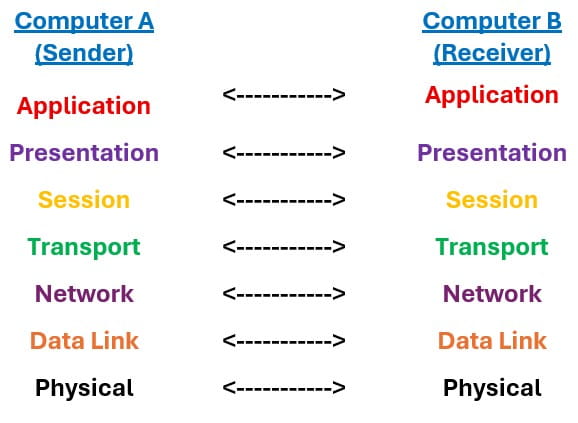
Network Models - Layered Approach

हर layer अपनी सामने वाली समान layer के साथ तार्किक रूप से जुड़ी होती है।

उदाहरण के लिए –

  • Transport Layer तार्किक रूप से दूसरी Transport Layer से जुड़ी होती है।
  • Network Layer तार्किक रूप से दूसरी Network Layer से जुड़ी होती है।

लेकिन वास्तव में data सीधे एक layer से दूसरी layer तक नहीं जाता।

सबसे पहले sender की ओर data ऊपर से नीचे की layers से गुजरता है।

इसके बाद network के माध्यम से यात्रा करता है।

फिर receiver की ओर नीचे से ऊपर की layers से गुजरता है।

इस प्रक्रिया को peer-to-peer communication कहा जाता है।

.

Advantages of Networking Models

Simplicity – जटिल communication को समझना आसान हो जाता है।

Standardization – सभी निर्माता एक जैसे नियमों का पालन कर सकते हैं।

Interoperability – अलग-अलग कंपनियों के devices आपस में communicate कर सकते हैं।

Easier Troubleshooting – समस्याओं को layer by layer ढूँढा जा सकता है।

Flexibility – नई technologies को आसानी से जोड़ा जा सकता है।

Better Maintenance – Network में बदलाव और रखरखाव करना आसान हो जाता है।

.

Disadvantages of Networking Models

Additional Overhead – प्रत्येक layer अतिरिक्त headers और control information जोड़ती है। इससे data size बढ़ जाता है।

Processing Delay – हर layer को अपना कार्य करना पड़ता है, जिससे थोड़ा अतिरिक्त समय लगता है।

Complexity for Beginners – शुरुआत में कई students को विभिन्न layers समझने में कठिनाई हो सकती है।

Theoretical Separation – वास्तविक implementations में कुछ layers एक-दूसरे के कार्यों से जुड़ सकती हैं। यह स्थिति विशेष रूप से OSI Model में अधिक दिखाई देती है।

.

हालाँकि कुछ सीमाएँ मौजूद हैं, फिर भी networking models आज भी communication systems को समझने का सबसे महत्वपूर्ण आधार हैं।

इसलिए Computer Networks पढ़ने की शुरुआत OSI Model और TCP/IP Model को समझने से करनी चाहिए।

Test Yourself

Q1- (IIT Bombay, B.Tech End Semester)
What is meant by interoperability in computer networks? How did the absence of a standard networking model affect early computer networks? How did networking models solve this problem?

Ans – Interoperability means the ability of different systems, devices, and software from different manufacturers to communicate and work together successfully over a network. A Windows laptop connecting to a Linux server, or a Cisco router forwarding packets from an Android phone — all of this is interoperability in action.

In the early days of networking, interoperability did not exist. Companies like IBM, DEC (Digital Equipment Corporation), and Xerox each built their own proprietary networking systems. IBM computers followed IBM’s rules. DEC computers followed DEC’s rules. The two could not communicate. If a university purchased IBM machines and its partner institution had DEC machines, data exchange required expensive, custom-built conversion hardware or physical transport of storage media. This problem was called interoperability failure and it severely limited the growth of networking.

Networking models solved this in two ways.

First, they established standardization — a common framework that all manufacturers could follow when designing products. If every manufacturer follows the same layer boundaries and interface rules, their devices can communicate regardless of internal implementation differences.

Second, they enforced separation of responsibilities through layering. Each layer has a defined job and a defined interface to the layers above and below it. As long as a manufacturer’s implementation respects these interfaces, it does not matter what technology is used internally.

Q2- (NIT Tiruchirappalli, B.Tech) — Explain the concept of layered communication with a suitable real-world analogy. What is meant by peer-to-peer communication in the context of networking models?

Ans – Layered communication means dividing the complex process of network communication into a series of smaller, manageable tasks, where each task is assigned to a specific layer. Each layer performs its own job independently and interacts only with the layers directly above and below it.

A very effective real-world analogy is the postal system. When you write a letter and post it, the process naturally divides into layers. You write the message — this is the Application Layer creating data. You seal it in an envelope — this is encapsulation, where the layer adds its own packaging. You write the addresses on the envelope — this is the addressing function of the Network Layer. The post office transports the envelope through sorting centres and delivery routes — this is routing and physical transmission. At the destination, the receiver opens the envelope and reads the message — this is decapsulation and delivery to the application. Crucially, you — the sender — never needed to understand how the post office sorted the mail internally. Each “layer” of the postal process did its own job.

Peer-to-peer communication is the concept that each layer on the sender’s side communicates logically with the corresponding layer on the receiver’s side, even though physically the data travels down through layers at the sender and up through layers at the receiver.

Q3- (IIT Madras, M.Tech Entrance) — What are the key characteristics of a well-designed layered networking model? Explain each characteristic with its significance in network design.

Ans – A well-designed layered networking model exhibits five key characteristics:

Separation of Responsibilities – This separation means that an engineer designing a routing protocol does not need to worry about whether the underlying medium is copper or fibre.

Layer Independence – A change in one layer should have minimal or no impact on other layers, as long as the interface between layers remains unchanged. The most powerful real-world example of this is Wi-Fi.

Service-Oriented Design — Each layer provides a service to the layer above it and uses the services of the layer below it.

Encapsulation Support — Each layer must be able to add its own control information (header, and sometimes trailer) to the data it receives from the layer above, before passing it downward.

Scalability — New technologies should be integrable into the model without requiring the entire system to be redesigned.

Q4- (Anna University, B.Tech Examination) – Compare the advantages and disadvantages of using a layered networking model. Is the overhead introduced by layering justifiable? Give reasons.

Ans –

Advantages

Simplicity – Complex communication becomes easier to understand.

Standardization – Manufacturers follow common rules.

Interoperability – Devices from different vendors can communicate.

Easier Troubleshooting – Problems can be isolated layer by layer.

Flexibility – Technologies can evolve independently.

Better Maintenance – Changes can be implemented efficiently.

Disadvantages

Additional Overhead – Each layer adds headers and control information. This increases transmission size.

Processing Delay – Every layer performs additional processing.

Complexity for Beginners – Students often find multiple layers confusing initially.

Theoretical Separation – Some layers overlap in practical implementations.

Is the overhead justifiable? Yes, overwhelmingly so. The alternative — monolithic, vendor-specific, non-interoperable networking — is far more costly in practical terms. The Internet serves over five billion users precisely because TCP/IP’s layered model allowed any device from any manufacturer to participate without custom engineering. The overhead of a few dozen bytes of headers is trivial compared to the alternative cost of custom conversion hardware at every network boundary. The productivity gained through global interoperability dwarfs any efficiency lost to header overhead.

Q5- Why is the OSI model called a reference model?

Ans – The OSI model is called a reference model because it was designed as a conceptual framework — a set of guidelines defining what each layer should do — rather than a set of specific protocols defining how to do it. No real network is literally built as seven distinct software modules labeled exactly as OSI describes. Instead, real-world protocols are designed to be broadly consistent with OSI’s layer responsibilities, and engineers use OSI as a common vocabulary for discussion and troubleshooting.

Q6- The OSI model has seven layers, but real networks do not implement all seven as separate modules. Does this make the OSI model useless? Justify your answer.

Ans – Not at all and this question reveals a fundamental distinction between a model and an implementation. The OSI model was never intended to be a blueprint for how to write networking software. It was intended as a conceptual framework, a way of thinking about the problem of network communication.

Q7- The OSI model was developed by which organization and in which year?
  1. IEEE, 1980
  2. ISO, 1984
  3. IETF, 1983
  4. DARPA, 1969

Ans – (2)

Explanation – The OSI (Open Systems Interconnection) model was developed by ISO, the International Organization for Standardization and published in 1984.

IEEE develops hardware-level standards like Ethernet (802.3) and Wi-Fi (802.11).

IETF develops Internet standards published as RFCs.

DARPA developed the TCP/IP protocol suite. 

Q8- The concept that the Transport Layer at the sender communicates logically with the Transport Layer at the receiver, even though data physically travels down and up through all layers is called
  1. Multiplexing
  2. Encapsulation
  3. Peer-to-peer communication
  4. Synchronisation

Ans – (3)

Explanation – Peer-to-peer communication in the context of networking models means that each layer on the sending side communicates logically and directly with its corresponding layer on the receiving side. 

Q9- Which of the following is a disadvantage of using a layered networking model?
  1. Devices from different vendors cannot communicate
  2. Each layer adds header information, increasing overall data size
  3. Troubleshooting becomes more complex
  4. Technologies at one layer cannot evolve independently

Ans – (2)

Explanation – each layer adds its own header (and sometimes a trailer in data link layer) to the data before passing it to the next layer. This increases the total size of the transmission compared to the original data.

BOOKS

Data Communication and Networking by Behrouz A. Forouzan

Computer Networks book - Computer Network by Behrouz A. Forouzan, Firouz Mosharraf

Computer Network book by Tannenbaum